
The study of fungus is called mycology. In scientific terms, fungi is any group of spore-producing organisms that feed on organic matter. These include molds, yeast, mushrooms, and toadstools.
So mushrooms are fungi, but they are not the only type. They reproduce with spores instead of seeds. The feed on organic matter that is dying. Fungi are our decomposers! When a tree goes down in the forest, with the help of fungus, the tree is turned back into nutrients for plants and animals and of course fungi.
Could you imagine what our world would look like if the dead plant and animal matter never decomposed?
Thank you fungi!! You do an incredible, necessary, and mostly invisible job!!
Are Mushrooms a Plant or Animal?
This is a fun fact. Mushrooms are not plants or animals, although they act a little like each of them. They are in their own category: fungi.
Mushrooms grow like plants. They need nutrients, they grow in the ground, they have roots, and they need some sunlight.
But plants take up CO2, and produce oxygen. Mushrooms do not!
In fact, scientifically, mushrooms are closer related to animals than to plants.
Animals and mushrooms, take up oxygen and produce CO2. That's right, mushrooms need oxygen to live!

First off, you need to know what a fruiting body of a mushroom is. It's the part that grows above ground. It's the part of the fungi that we call "mushroom".
Think of a mushroom, like an apple on a tree. The apple is the fruit of the tree, and it holds the seed of the tree. The mushroom is the fruit of the mycelium, and holds the spores of the fungi.
Cap / Pileus: is the top of the mushroom that is round, sitting on top of the stem. It houses the spore producing surface of the fruiting body, which consists of gills, teeth (like on lion's mane) and spores.
Scales: these are parts of the mushroom that form hard-shelled protection for the fungi. They often appear in various shapes and sizes. Scales are often developed from the left over parts of the universal veil.
Margin: a mushroom cap margin is the edge of the cap, where the surface meets the underside. The margins can exhibit specific characteristics that will aid in identification.
Gills: the scientific name is lamellae. They are thin, papery structures that hang vertically under the cap. They house the spores, and their sole purpose is to produce spores. The spores are then dropped by the gills by the millions in which they are scattered by the winds, insects, and animals, to make more mycelium and mushrooms.
Spores: a uni-cellular organism (one cell) paramount to he reproduction and growth of mushroom fungi. The spore of a mushroom contains all the necessary materials to form a new fungus. A fruiting body - the mushroom - will release millions of tiny spores. They are often different colors ranging from white, cream, yellow, green, purple, brown, rust, or black.
Ring / Annulus / Collar: this is the ring-like or collar-like structure sometimes found on the stipe or stem, of the mushroom. The annulus represents the remnants of the partial veil, after it has ruptured to expose the gills or other spore-producing surface.
Partial Veil / Veil / Velum / Inner Veil: the thin membrane that covers the gills and stem of an immature mushroom. It's temporary, and is broken as the mushroom fruiting body grows bigger, and the cap is ready to have the gills spill the spores. The spores won't drop from the mushroom until the inner veil has been broken.
Stem / Stipe / Stalk: a stalk-like feature of a fruiting body, that supports the cap. It also will often have the partial veil attached to it, and hanging from it, after the veil has been ripped open.
Universal Veil / Outer Veil: is the thin temporary membrane that fully envelops immature fruiting bodies of certain gilled mushrooms.
Volva/Base/Bulb: A cup like structure at the base of the stalk of certain mushrooms, that is a remnant of the universal veil.
Mycelium: a network of fungal threads or hyphae. Mycelia often grown underground, but sometimes the mycelium will grow on the outside of a mushroom - like with fuzzy feet!

Fuzzy Feet: the fuzzy white stuff that will grow on the bottom of your mushrooms sometimes. This is nothing to worry about! It's actually just aerial mycelium, and completely safe to eat. Some people believe they develop when the mushroom doesn't have enough oxygen. I have not been able to tell this either way. I have some mushrooms that seem to have plenty of oxygen and still get fuzzy feet, and others that have not been aired out for a bit (not a ton of oxygen) with zero fuzzy feet. It might have to do with the level of humidity, but I really couldn't tell from my non-scientific experience.

The Life Cycle of a Mushroom
I love this little diagram above. It is missing a couple of items that I will talk about. There is another diagram coming up below as well that has a few more items on there.
Understanding the life cycle and the parts of the mushroom, are incredibly important when you start reading about mushrooms, and want to grow them. People will use the language of parts and phases of mushrooms, so you need to learn them!
Inoculation and Germination
A spore is kind of like a seed from a plant, but it's totally not a seed. It's what fungi use to reproduce.
The full-grown mushrooms releases millions of spores. Then inoculation occurs. That means the spores land on something in which the environment allow for the spores to start growing. This is called spore germination.
Spore germination is when a strand of hypha emerges from the spores. A mass of hyphae make up the body of a fungus, which is called mycelium (plural, mycelia).
Spore germination can only happen if the environment is just right. It usually needs high humidity, and a favorable temperature and a food source. There always needs to be presence of water and oxygen.

After germination has begun, the mycelium continue to grow as quickly as possible. There are lots of different organisms that are competing for the food in this environment, and it's important to get a strong hold and out-grow them.
During this stage the developing mycelium break down organic matter and absorb nutrients from the surroundings. The mycelium expand at an exponential rate. Below is a picture of grain spawn in a jar. It's been fully colonized by the mycelium, meaning taken over completely the food source in this jar, and actively breaking down the grain.
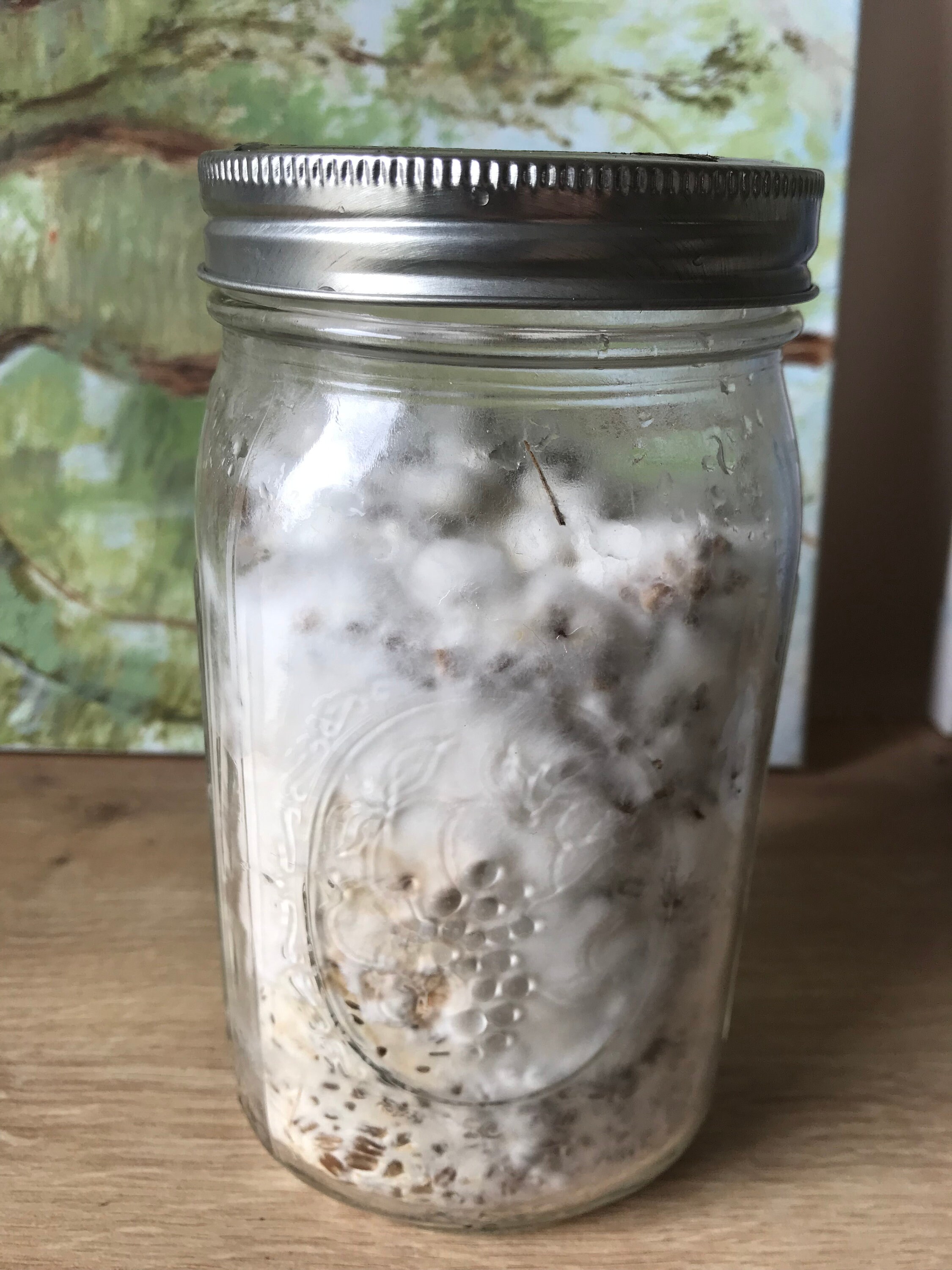
Eventually, the mycelium wants to start fruiting. To do that it will first create something called a hyphal knot. You can think of a hyphal knot as the beginning of a young mushroom, which is also knows as a primordium. These baby mushrooms or "pins" form a pinhead as it starts to evolve and sprout from it's mycelial phase. This phase is also called pinning.
The picture below shows both pins and hyphal knots. The pins are colored, and look like the tiniest of baby mushrooms. They knots are white concentrated spots, that look like some thread has knotted up.

When you read about others growing mushrooms, they will talk about "pins", and now you know what they are talking about. It's the smallest form of a fruiting body of the mushroom starting to grow. They look just like the top of a sewing pin.

During pinning, mushrooms use cell division to form al the cells they need to produce the final mature mushroom.
However, once pinning is complete, they no longer use cell division to grow. Instead, they flood the existing cells with water and nutrients, allowing them to expand rapidly.
That is why mushrooms can grow in a matter of hours... pinning to fully grown mushroom opening to spore! No joke!
Fruitbody Selection
From thousands of primordia (the baby "pins"), the growing fungi selects the most promising few to develop into mature fruitbodies, or mushrooms. This is called fruitbody selection.
Mature Fruitbody

The fungi channels all of it's energy and nutrients to develop the fruitbody, which will then produce spores, allowing the fungi to reproduce and to spread. Spore generation is the sexual reproduction phase of the mushroom life cycle.
Mushrooms typically reproduce asexually. Although, they do have the ability to reproduce sexually when two compatible mycelia clumps fuse.
Mushrooms can release trillions of spores everyday, but they don't produce spores all the time. Once the temporary veil breaks, the spores start to release, and release until there are no more spores left, and the mature fruitbody is picked, or starts to rot.


No comments:
Post a Comment